
Probate Law in California: A Modern Guide to the 2026 Legal Process
- 3 days ago
- 12 min read
Did you know that the average estate in the Golden State remains trapped in court for 12 to 18 months before assets ever reach the beneficiaries? It's a staggering delay that leaves many families feeling anxious and overwhelmed. You likely worry that high legal fees will drain the estate's value before your loved ones see a dime. We understand that the traditional approach to probate law california feels slow, expensive, and unnecessarily complicated for a modern family.
You deserve a faster way forward. This 2026 guide provides the clarity you need to handle the court process with confidence. We'll show you exactly how to manage executor duties, understand statutory fee structures, and implement modern strategies to avoid probate altogether. From leveraging AI-driven legal support to mastering the court roadmap, you're about to discover how to protect your legacy with the efficiency of a digital-first partner. Let's turn a daunting legal hurdle into a streamlined, manageable plan.
Key Takeaways
Navigate the updated 2026 roadmap for estate administration, from the initial petition to the formal appointment of a personal representative.
Learn how to accurately calculate statutory fees and court expenses under probate law california to avoid financial surprises during administration.
Discover modern estate planning strategies, such as Living Trusts and TOD designations, that allow your assets to bypass the court system entirely.
Explore how tech-driven legal support and 24/7 AI accessibility can accelerate the probate cycle for faster, more efficient asset distribution.
Gain clarity on the California Probate Code to ensure a transparent process that prioritizes swift results and professional guidance.
Table of Contents Understanding California Probate Law: Why It Happens and What It Covers The 2026 California Probate Timeline: A Step-by-Step Roadmap Calculating the Real Cost: California Statutory Fees and Court Expenses How to Avoid Probate: Modern Estate Planning Strategies Navigating Probate with Modern Legal Support
Understanding California Probate Law: Why It Happens and What It Covers
Probate is the formal, court-supervised process used to settle a person's estate after they pass away. It focuses on authenticating a last will and testament, paying off valid debts, and distributing the remaining assets to rightful heirs. In our state, the California Probate Code serves as the primary legal framework. It provides a rigid set of rules that every executor or administrator must follow to ensure transparency and fairness. This structured system makes probate law california one of the most detailed in the United States, designed to prevent fraud and resolve disputes before they escalate.
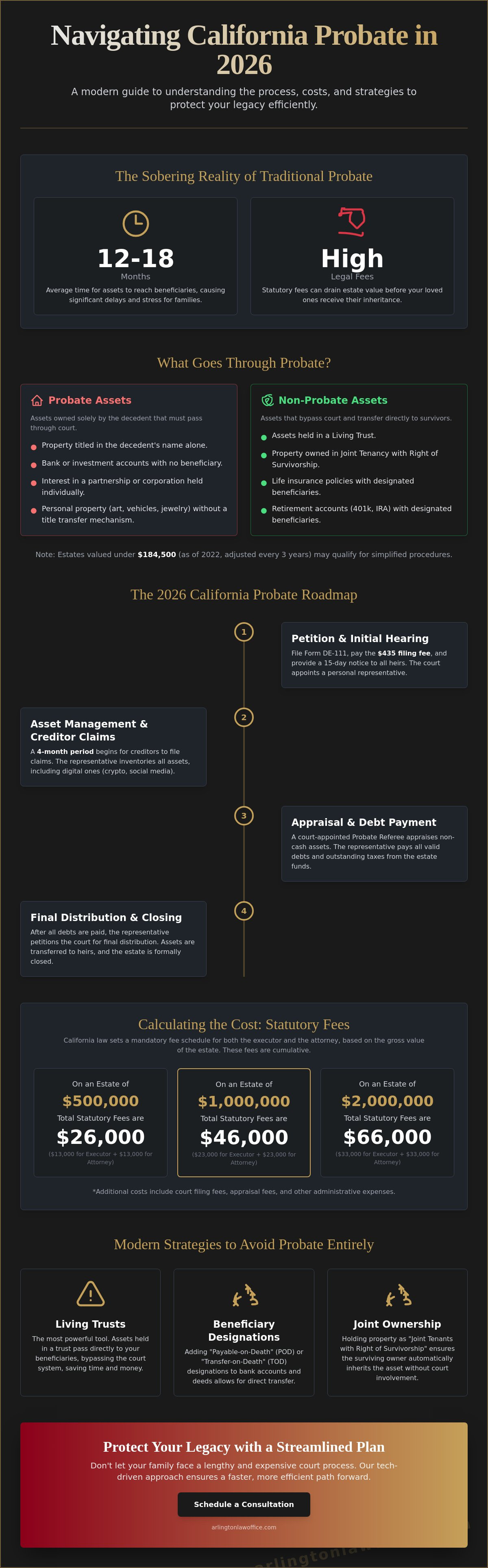
Distinguishing between asset types is the first step in any administration. Probate assets are those owned solely by the decedent, such as a house held in their name alone or a personal bank account without a designated beneficiary. Non-probate assets bypass the court entirely. These include property held in joint tenancy, assets placed in a living trust, and life insurance policies with specific beneficiaries. Understanding the Probate Process is essential because it clarifies which items require a judge's oversight and which can be transferred immediately to survivors.
When is Probate Legally Required in California?
California provides a "Small Estate" exception to help families avoid the full court process. As of the April 1, 2022 adjustment, estates valued under $184,500 generally qualify for simplified procedures. This limit is updated every three years; the next adjustment occurs on April 1, 2025, which will dictate the threshold for 2026 filings. If a valid Will exists, the court oversees the executor's actions to ensure the document's instructions are met. Without a Will, the court applies "intestate succession" laws to distribute property to the closest living relatives. Under California law, an "Estate" encompasses the total collection of a decedent's assets, debts, and legal rights that are subject to distribution through a court proceeding.
The Role of the Probate Court
The Superior Court in the county where the decedent lived holds exclusive jurisdiction over these matters. It's a protective environment. The court ensures that creditors receive notice and payment while simultaneously guarding the rights of beneficiaries from mismanagement. To grant legal authority, the court issues specific documents known as "Letters Testamentary" for executors named in a Will or "Letters of Administration" when no Will is present. These papers allow the representative to move funds, sell property, and execute the final wishes of the deceased. Our firm focuses on making this transition swift and efficient through clear, tech-driven guidance.
The 2026 California Probate Timeline: A Step-by-Step Roadmap
Navigating probate law california requires a clear, tech-driven strategy to avoid unnecessary delays. The process generally takes 9 to 18 months, depending on the estate's complexity and the court's current backlog. Efficiency is our priority at Arlington Law Office, where we combine legal authority with modern tools to move your case forward swiftly.
Filing and Initial Court Procedures
The journey begins by filing Form DE-111, the Petition for Probate. You must pay a standard filing fee, which currently sits at $435 in most California counties. Once filed, you're required to provide a mandatory 15-day notice of the hearing to all heirs and beneficiaries named in the Will. If a party chooses to contest the Will during this phase, the court pauses the appointment process to hear arguments, which can extend the timeline by several months. For a deeper dive into these initial requirements, consult California's Official Probate Guide for specific local rules. Our RoseBots AI can help you track these initial deadlines 24/7 so you never miss a filing window.
Managing Assets and Creditor Claims
After the court issues Letters of Administration, the 4-month creditor claim period begins. You must notify all known creditors, giving them this window to file a claim against the estate. While handling traditional property, 2026 standards require executors to be tech-savvy. You must inventory digital assets, including cryptocurrency wallets, social media accounts, and monetized digital platforms. The California Probate Referee acts as an independent state-appointed official who appraises non-cash assets to ensure accurate estate valuation for tax and distribution purposes. This step ensures transparency and protects the executor from future disputes regarding asset worth.
Final Distribution and Closing
Once debts are settled and the 4-month claim period expires, you'll prepare a final accounting report. This document details every dollar that entered and left the estate. If the process hits a snag, you can petition for "Preliminary Distributions" to get funds to beneficiaries sooner. This is a common strategy when waiting for a final tax clearance. To finish, you'll request a Judgment of Final Distribution. This legal order allows you to transfer remaining assets and officially discharges you from further liability. If you're feeling overwhelmed by the paperwork, you can explore our membership clubs for on-demand legal support that simplifies these complex steps.
Calculating the Real Cost: California Statutory Fees and Court Expenses
Probate law california operates on a rigid, transparent fee system that catches many families by surprise. Unlike other states where legal fees might be negotiated hourly, California uses a "Statutory Fee" schedule. These fees are set by law and represent the minimum an attorney and an executor can charge for their services. You can review the specific legal framework in the Full Text of the California Probate Code. This structure ensures you know the baseline cost upfront, but the numbers can climb quickly because they're based on the gross value of the estate.
The gross value refers to the total fair market value of all assets before any debts are subtracted. If a decedent owned a home worth $1,000,000 with a $700,000 mortgage, the probate fees are calculated on the full $1,000,000. The $700,000 debt doesn't reduce the fee base. This makes probate law california particularly expensive for homeowners in high-value real estate markets.
The Statutory Fee Schedule Breakdown
The state uses a sliding scale to determine compensation. Both the attorney and the executor are entitled to these fees. If both take their full share, the cost effectively doubles. The current rates are 4% of the first $100,000, 3% of the next $100,000, and 2% of the next $800,000. For estates larger than $1 million, the rate drops to 1% for the next $9 million.
Hidden Costs of Probate
Statutory fees are just the beginning. Several administrative expenses are mandatory. You'll face a court filing fee, which is currently $435 in most counties. You're also required to publish a "Notice of Petition to Administer Estate" in a local newspaper to alert potential creditors. This publication fee typically ranges from $300 to $600 depending on the publication's reach and county rules.
Every probate case requires a Probate Referee. This is a court-appointed appraiser who values non-cash assets like real estate and jewelry. They charge a fee of 0.1% of the assets they appraise. Additionally, if the executor lives outside of California, the court usually requires a probate bond. This is a type of insurance policy that protects the heirs from financial mismanagement. Bond premiums vary based on the estate's value but add another layer of expense to the process.
Finally, be aware of "Extraordinary Fees." These are additional charges for work that goes beyond standard administration. If the estate involves complex tax returns, the sale of a business, or litigation between heirs, the attorney can petition the court for higher pay. Our office focuses on swift, tech-driven solutions to keep these complexities from spiraling into unnecessary costs.
How to Avoid Probate: Modern Estate Planning Strategies
You don't need to let a courtroom decide your family's future. Bypassing the complexities of probate law california is possible with proactive, tech-forward planning. By implementing modern strategies, you ensure your assets move at the speed of your life, not the speed of the legal system. Our firm focuses on high-tech, high-touch solutions that keep your private matters out of the public eye.
The Revocable Living Trust remains the primary vehicle for avoiding court. It acts as a private contract that holds your assets, allowing them to pass to beneficiaries without a judge's intervention. Beyond trusts, you can use "Payable on Death" (POD) and "Transfer on Death" (TOD) designations for financial accounts. These tools act as direct pipelines to your heirs. For real estate, Joint Tenancy with Right of Survivorship allows property to transfer instantly to a co-owner. For smaller holdings, the state provides a Small Estate Affidavit. As of April 1, 2022, this applies to estates valued under $184,500. This threshold is adjusted every three years, with the next update scheduled for April 1, 2025, which will dictate the rules for 2026 and beyond.
The Benefits of a Revocable Living Trust
Efficiency is the greatest advantage of a trust. While a standard California probate case often lasts 12 to 16 months, a trust allows for immediate asset distribution. This swiftness is vital for families who need access to funds for daily expenses or mortgage payments. Privacy is another critical factor. A Will becomes a public record once it enters probate, meaning anyone can view your assets and debts. A trust remains entirely private, keeping your financial legacy secure.
Understanding probate law california helps you see why a trust is superior from a cost-benefit perspective. Setting up a trust requires an upfront investment, but it eliminates statutory probate fees later. In California, these fees are set by law. On a $1,000,000 estate, the attorney and executor could each claim $23,000. A trust saves your family tens of thousands of dollars in unnecessary administrative costs and legal hurdles.
Simplified Procedures for Spouses and Small Estates
If you're a surviving spouse, you can use the Spousal Property Petition (Form DE-221). This streamlined process confirms your right to the property without a full probate trial. For those handling smaller balances, the Affidavit for Collection of Personal Property provides a fast way to claim bank accounts or vehicles after a 40-day waiting period. You must ensure your beneficiary designations on insurance policies or retirement accounts are current, as these designations override any instructions left in a Will. This hierarchy of legal documents is a frequent point of confusion for many families.
Ready to protect your legacy with a modern approach?
to start your plan.
Navigating Probate with Modern Legal Support
Arlington Law Office transforms the traditional legal experience into a streamlined, on-demand service. We move beyond the old transactional model that leaves families waiting for weeks. As your Modern Protector, we combine legal authority with 24/7 accessibility. This approach is vital for families dealing with probate law california complexities, where the standard court process can take 12 to 18 months to conclude. We use tech-driven efficiency to shorten this cycle and keep your family moving forward.
Our firm serves as a sophisticated bridge for out-of-state heirs. If you live in another state but are managing a California estate, you need a partner with a national footprint and local expertise. We offer the specialized knowledge required to handle local court requirements while providing a digital-first interface. This ensures you stay informed regardless of your time zone or location.
Efficiency Through Innovation
We prioritize speed and transparency through our unique service model. Our RoseBots AI assistants handle routine document tracking and status updates. This automation allows our legal team to focus on high-level strategy and personalized guidance for your specific situation.
AI-Driven Support: RoseBots ensure no court deadline is missed. They provide a layer of precision that manual offices cannot match.
Legal Service Clubs: We offer subscription-based tiers. These Clubs replace unpredictable billable hours with clear, manageable estate management options.
Multilingual Reach: Our team provides full support in English, Spanish, and Vietnamese. We ensure every family member understands the legal roadmap.
Next Steps for Executors and Families
The first 48 hours after a loss are critical for securing estate assets. A swift initial consultation helps prevent unauthorized access to property or financial accounts. Our mobile app provides real-time case updates. You never have to wonder about the status of your filing. You get instant access to your legal team and case documents from any smartphone.
Managing probate law california mandates requires a decisive partner. We help you move from a state of inquiry to a state of action. Secure the estate and protect the beneficiaries without the usual legal headaches. Our team is ready to provide the high-tech, high-touch service your family deserves.
Schedule your focused probate consultation with Arlington Law Office today.
Take Charge of Your Family's Future Today
Navigating the complexities of probate law california in 2026 demands a shift from outdated methods to streamlined, tech-forward solutions. The legal roadmap is clearer when you understand the specific court deadlines and statutory fee structures that govern the process. Whether you're managing an active estate or building a plan to avoid court entirely, speed and precision are your best tools. Arlington Law Office bridges the gap between traditional legal expertise and modern convenience. Our firm is ranked best in customer service for modern legal solutions because we prioritize your peace of mind. We offer multilingual support in English, Spanish, and Vietnamese to ensure every family member stays informed. Our AI-powered RoseBots provide 24/7 connectivity, so your questions never go unanswered. You don't have to face the California court system alone. We're here to make the process swift, transparent, and accessible for everyone. Let's build a plan that protects what matters most to you.
Frequently Asked Questions
Is probate mandatory in California if there is a Will?
Probate is mandatory in California if the estate's total value exceeds $184,500. While a Will provides instructions for asset distribution, it doesn't bypass the formal requirements of probate law California. This threshold is updated periodically to reflect inflation and economic shifts. Small estates under this limit can often use a simplified affidavit process under California Probate Code Section 13100 to avoid court.
How long does the average probate process take in California in 2026?
In 2026, the average probate process in California takes 12 to 18 months to complete. Court backlogs in densely populated counties often extend this timeline beyond a year. You should expect the initial petition to take 4 to 6 months just to receive a hearing date in the current legal climate. Complex estates with real estate or tax disputes can stretch to 24 months or longer.
Can I handle a California probate case if I live in another state?
You can manage a California probate case from any state or country without traveling for every hearing. Arlington Law Office utilizes digital filing systems and remote appearances to represent out-of-state executors efficiently. California law requires you to appoint a process agent if you live outside the state. Our 24/7 AI support and mobile app keep you updated on your case status regardless of your time zone.
How much does an attorney charge for probate in California?
Attorney fees for probate law California cases are strictly set by California Probate Code Section 10810. These statutory fees start at 4% of the first $100,000 and 3% of the next $100,000. For an estate valued at $500,000, the statutory attorney fee is exactly $13,000, which is paid from the estate assets. This transparent structure ensures you know exactly what the legal costs will be.
What assets are exempt from probate under California law?
Assets held in a Living Trust, property in joint tenancy, and accounts with designated beneficiaries bypass probate entirely. Life insurance payouts and retirement accounts like 401(k)s also transfer directly to heirs outside of court. These non-probate assets move to beneficiaries immediately upon the presentation of a death certificate to the institution. Utilizing these tools allows families to access funds within weeks rather than waiting for a court order.
What happens if someone dies without a Will in California (Intestacy Laws)?
California’s intestacy laws dictate asset distribution if someone dies without a Will. Under Probate Code Section 6401, a surviving spouse typically inherits all community property and a portion of separate property. The remaining assets are divided among children, parents, or siblings based on a rigid legal hierarchy. If no relatives are found, the state eventually claims the assets through a process known as escheatment under Section 6800.
Can I avoid probate by just having a simple Will?
A simple Will doesn't help you avoid probate. It serves as a roadmap for the court but still requires formal judicial oversight to transfer titles and clear debts. Wills are public documents, meaning anyone can view your asset distribution once the case is filed. To bypass the court system entirely, you need a Revocable Living Trust, which keeps your private financial matters out of the public record.
How do I fire or replace an executor who is not doing their job?
You can replace an executor by filing a petition for removal under California Probate Code Section 8502. Common grounds for removal include mismanagement of estate assets or failure to provide an accounting within the 60 day legal window. Our team uses swift legal action to protect your inheritance from negligent or dishonest representatives. The court prioritizes the protection of the estate, so demonstrating a breach of fiduciary duty is the most effective path.


Comments