
Estate Planning: The Modern Guide to Protecting Your Family and Legacy in 2026
- 2 days ago
- 13 min read
Updated: 21 hours ago
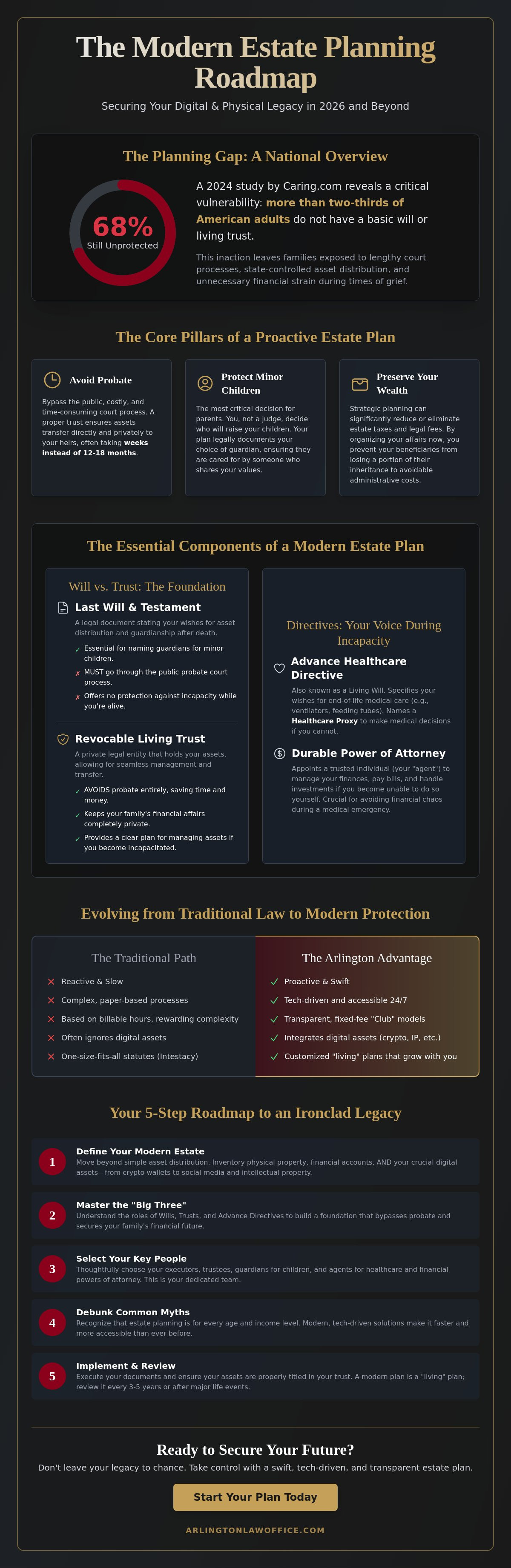
A 2024 study by Caring.com revealed that 68% of American adults still lack a basic will or trust. You likely feel that organizing your legacy is a daunting task that can always wait for another day. It's common to worry about assets getting trapped in a year long probate process or feeling confused about the legal nuances of modern estate planning. At Arlington Law Office, we believe securing your future should be swift, tech-driven, and entirely transparent.
You deserve a plan that protects your family without the traditional legal headache. This guide helps you master the essentials to secure your assets and provide lasting peace of mind for your loved ones. We'll provide a clear understanding of 2026 legal requirements and a streamlined process to protect your minor children and digital assets. By the end of this article, you'll have a roadmap to create an ironclad legacy that works at the speed of the digital world.
Key Takeaways
Define modern estate planning as a comprehensive strategy for protecting your digital assets and managing incapacity, moving far beyond simple asset distribution.
Master the "Big Three" legal components-Wills, Trusts, and Advance Directives-to bypass the probate process and secure your family's financial future.
Debunk common myths and discover how tech-driven solutions make building a legacy fast and accessible for every age and income level.
Follow a streamlined five-step roadmap to inventory your physical and digital assets while selecting a dedicated team of guardians and executors.
Explore how 24/7 AI-driven support and innovative legal "Clubs" provide a swift, transparent bridge between traditional law and modern efficiency.
Table of Contents What is Estate Planning and Why Does it Matter in 2026? The Essential Components of a Modern Estate Plan Addressing Common Misconceptions and Objections 5 Steps to Building Your Comprehensive Estate Plan The Arlington Advantage: Tech-Forward Estate Planning
What is Estate Planning and Why Does it Matter in 2026?
Estate planning is a proactive strategy for managing your life, your assets, and your legacy. It isn't just a stack of documents tucked away in a filing cabinet. It's a dynamic framework designed to protect you during incapacity and ensure the swift distribution of your property after you pass. In 2026, your estate includes much more than physical real estate or a savings account. It encompasses your entire digital footprint, from cryptocurrency wallets and specialized software licenses to social media accounts and cloud-based intellectual property. Understanding What is Estate Planning? is the first step toward securing these diverse assets against legal uncertainty.
The traditional legal model is often slow, reactive, and built on billable hours that reward complexity. We take a different path as a "Modern Protector." This approach prioritizes speed and tech-driven accessibility, ensuring your plan stays current with changing laws. If you fail to create a plan, you fall into "Intestacy." This means the state government decides who receives your assets based on rigid, one-size-fits-all statutes. These laws often ignore modern family structures and your personal preferences, leading to public court battles and family friction.
The Shift from Death Planning to Legacy Management
Modern estate planning is for everyone, not just the ultra-wealthy. It's a common misconception that you need a multi-million dollar portfolio to justify a plan. In reality, 67% of Americans currently lack a basic will, leaving their families vulnerable to administrative delays. A "living" plan grows with you as you start a business, buy a home, or expand your family. It focuses heavily on incapacity planning. If a medical emergency leaves you unable to communicate, your plan dictates who manages your finances and makes healthcare decisions. This keeps you in control even when you can't speak for yourself.
Key Benefits of a Proactive Estate Plan
A proactive estate planning strategy offers clear, measurable advantages for you and your beneficiaries:
Avoiding Probate: This court-supervised process can last 12 to 18 months and is entirely public. A well-structured plan allows assets to pass directly to heirs, keeping your private matters out of the courthouse.
Guardian Selection: For parents, this is the most critical step. You choose who will raise your minor children. Without a plan, a judge who doesn't know your family values will make that choice for you.
Minimizing Costs: Strategic planning helps reduce potential estate taxes and unnecessary legal fees. By organizing your affairs now, you prevent your beneficiaries from spending thousands on future litigation.
We use AI-driven support and 24/7 connectivity to make this process seamless. Your legacy deserves a modern solution that moves as fast as you do.
The Essential Components of a Modern Estate Plan
A modern estate plan isn't a static folder in a dusty cabinet. It's a dynamic system designed to protect your assets and your dignity. You need to focus on the "Big Three": Wills, Trusts, and Advance Directives. These documents work together to provide a safety net for your family. Understanding the legal framework of estate planning is the first step toward securing your legacy in a fast-paced world.
Wills vs. Trusts: Choosing the Right Foundation
A Last Will and Testament is a fundamental building block. It lets you name an executor and appoint guardians for minor children. However, a Will has limitations. It must go through probate, a court-supervised process that is public and often slow. In many states, probate can take 6 to 18 months to conclude. If you want speed and privacy, consider a Revocable Living Trust. Trusts allow for the immediate transfer of assets without court intervention. While a Will is often cheaper to draft, a Trust avoids the high costs and delays of the probate system later.
Advance Healthcare Directives and Living Wills
Estate planning also protects you while you're still here. A Living Will specifically outlines your preferences for end-of-life medical treatment, such as ventilators or feeding tubes. This is separate from a standard Will. You also need to name a Healthcare Proxy. This person makes medical decisions on your behalf if you're incapacitated. Ensure your legal package includes HIPAA waivers. Without these, privacy laws might prevent doctors from sharing your medical status with your family during an emergency.
Your plan must also address your financial life through a Power of Attorney (POA). A Financial POA grants a trusted individual the authority to pay your bills and manage investments if you can't. We also emphasize the importance of your "Digital Legacy." This covers your cryptocurrency private keys, social media accounts, and cloud storage. A 2023 industry report found that 67% of adults haven't documented their digital passwords for their heirs. You can use the tools at Arlington Law Office to begin organizing these modern assets with swift, tech-driven support.
Don't overlook your beneficiary designations. Your 401k, IRA, and life insurance policies operate outside of your Will. They transfer directly to the person named on the account. If your Will names one heir but your 401k names another, the account designation usually wins. We recommend reviewing these designations every 24 months or after any major life event to ensure your plan remains accurate and effective.
Addressing Common Misconceptions and Objections
Many people delay estate planning because they believe it's a task reserved for the ultra-wealthy or those nearing retirement. This mindset puts your assets at unnecessary risk. If you own a home, hold a life insurance policy, or have children, you have an estate worth protecting. Middle-class families benefit significantly from asset protection strategies that shield home equity and savings from creditors or nursing home costs. You don't need a private island to justify a solid legal foundation. You just need a desire to keep your family out of court and out of conflict.
Speed is another common concern. Traditional law firms often drag out the process over several months of slow, paper-heavy correspondence. We've changed that rhythm. Our tech-driven approach utilizes digital-first workflows to move you from inquiry to execution in a fraction of the time. You can start the process today and have peace of mind by next week. We focus on efficiency because we know your time is valuable. Our goal is to act as your modern protector, using innovation to cut through the red tape that usually slows down legal matters.
Is Estate Planning Too Expensive?
Viewing legal fees as a cost rather than an investment is a frequent mistake. Probate costs typically range from 3% to 8% of the total estate value, often exceeding the price of a comprehensive plan by thousands of dollars. We've moved away from the intimidating billable-hour model. Instead, we offer tiered service Clubs that make professional help accessible to everyone. Whether you choose our Basic, Standard, or Premium membership, you receive transparent pricing and high-touch service. This subscription-style model ensures you're never surprised by a bill while your family remains protected.
The Risks of DIY Legal Documents
Generic online templates are often a trap for the unwary. Laws vary wildly from state to state; a form that works in one region might be completely invalid in another. A single misplaced word or a missing witness signature can lead to years of expensive litigation for your heirs. We solve this by integrating RoseBots AI to verify document accuracy against current legal standards. This technology-driven oversight ensures your documents are precise and enforceable. You get the speed of a digital platform combined with the authority of a professional legal team. Don't risk your legacy on a static PDF when you can have 24/7 AI-driven support and expert human verification.
Accessibility: Service tiers designed for every budget level.
Accuracy: RoseBots AI verification to prevent common drafting errors.
Speed: Digital workflows that replace weeks of waiting with days of action.
Protection: Strategies tailored for middle-class asset security.
Stop waiting for the perfect moment to start your estate planning journey. The best time to protect your future was yesterday; the second best time is right now. Our team is ready to guide you through our streamlined process with the focus and urgency your family deserves.
5 Steps to Building Your Comprehensive Estate Plan
Building a solid plan takes more than just signing a single document. It requires a structured approach to ensure your legacy remains intact and your family stays protected. Effective estate planning is about creating a roadmap that works when you can't, utilizing modern tools to simplify a traditionally complex process. Follow these five steps to secure your future with precision and clarity.
Step 1: The Asset and Digital Audit
Start by identifying exactly what you own. This includes physical property like your home and vehicles, financial accounts such as 401(k)s or brokerage accounts, and insurance policies. In 2024, your digital footprint is just as significant. The average person now manages over 100 digital accounts; you must document logins for social media, crypto wallets, and cloud storage for your executor.
To ensure your vehicle values are documented accurately for probate and inheritance, you can check out Kfzgutachten-Ari as a resource for professional appraisal standards.
Titling your home or bank accounts correctly is a vital part of protecting assets from unnecessary probate delays. Use a simple spreadsheet to list your deeds and account numbers. Ensure your executor knows where to find your master password list or digital vault key. This organization prevents your hard-earned wealth from being lost in the digital ether.
Step 2: Selecting Your Fiduciaries
Your "Team" is the backbone of your plan. You need an Executor to handle the immediate legal process of probate and a Trustee to manage assets over a longer period. These roles require different strengths. An Executor must be organized and detail-oriented, while a Trustee needs financial literacy and long-term vision.
Don't overlook the importance of naming backup guardians for your children. Statistics from 2023 show that nearly 60% of parents haven't named a legal guardian, leaving the decision to a judge if the unthinkable happens. Once you've chosen your representatives, have "the talk" with them. Confirm they're willing to serve and understand your expectations. Clear communication now prevents confusion later.
Step 3: Define Distribution Goals
Decide who gets what and when they get it. You don't have to distribute everything at once. Many people choose milestones, such as age 25 or 30, to ensure beneficiaries are mature enough to handle an inheritance. Be specific about family heirlooms to avoid disputes. Clarity is the best gift you can leave your loved ones.
Step 4: Draft and Execute Legal Documents
Professional guidance is non-negotiable here. DIY templates often fail to meet state-specific requirements, leading to estate planning documents being declared invalid in court. Work with a professional to draft your Will, Trust, and Power of Attorney. Ensure every signature is witnessed and notarized according to current legal standards.
Step 5: Store and Share Your Plan
A plan no one can find is a plan that doesn't exist. Move beyond the dusty filing cabinet and utilize secure digital vaults. These platforms allow you to share access with your fiduciaries instantly. Keep your physical originals in a fireproof safe and ensure your "Modern Protector" team has the digital key.
Take the first step toward total peace of mind. Start your estate planning journey today with our tech-forward legal support.
The Arlington Advantage: Tech-Forward Estate Planning
Traditional law firms often feel slow, stiff, and intimidating. Arlington Law Office breaks that mold. We act as a sophisticated bridge between established legal authority and modern digital efficiency. You won't wait days for a return call to get basic answers. Our RoseBots AI provide 24/7 support for immediate inquiries, ensuring you're never left in the dark. This tech-forward approach ensures your estate planning needs are met on your schedule, not ours. We prioritize your interests by combining high-tech tools with high-touch service.
We believe in building lasting relationships rather than one-off transactions. Our "Club" membership model moves away from the outdated billable-hour system. By organizing services into Basic, Standard, and Premium tiers, we provide a transparent progression of value. These memberships offer ongoing maintenance so your plan stays current as your life evolves. Diversity is a core strength of our firm. We provide full legal support in English, Spanish, and Vietnamese to ensure every family feels heard and protected.
Swift and Focused: Our Planning Process
Speed and clarity define our workflow. We use a dedicated mobile app to keep your vital documents at your fingertips. You can review your trust, will, or power of attorney from your phone at any time. We've optimized our internal systems to move from the initial consultation to a completed plan in record time. Many clients receive their finalized documents within 7 to 10 business days. This "on-demand" legal support fits the lifestyle of modern families who value efficiency. We remove the friction from the legal process so you can focus on what matters most.
Secure Your Legacy Today
Procrastination is the biggest threat to your family's financial security. It's never too early to start, regardless of your current age or the size of your bank account. You deserve the peace of mind that comes with a "best-in-class" customer service experience. Our team consistently ranks at the top for client satisfaction because we put your needs first. We've expanded our reach to handle immigration and estate planning across all 50 states, making us a versatile partner for your future. Don't leave your legacy to chance or outdated legal methods. Experience a firm that values innovation and accessibility. Schedule your modern estate planning consultation with Arlington Law Office.
Secure Your Legacy for 2026 and Beyond
Protecting your assets requires more than a dusty folder in a filing cabinet. You now understand that a modern strategy involves digital asset management and clear directives that account for the shifting legal landscape of 2026. Arlington Law Office simplifies this process by combining professional authority with tech-driven accessibility. We've eliminated the friction of traditional law by offering 24/7 RoseBots AI legal assistant support and a multilingual team fluent in English, Spanish, and Vietnamese. Our firm is ranked best in customer service because we prioritize your peace of mind and provide swift, on-demand guidance. Effective estate planning is the most significant gift you can leave your family. It's about clarity, speed, and certainty. Don't let your hard work be tied up in probate or stalled by outdated paperwork. We're ready to help you move from inquiry to action with a plan that's as innovative as it is secure. Your future starts with a single, decisive step toward protection.
Frequently Asked Questions
What is the difference between a Will and a Trust?
A Will takes effect only after death and requires probate court oversight, while a Trust functions during your lifetime and avoids court entirely. According to a 2023 study by Caring.com, only 32 percent of Americans have a Will. Trusts offer immediate asset transfer, whereas probate can take 6 to 12 months to finalize. Choose a Trust if you want privacy and speed for your heirs.
Do I need an estate planning lawyer if I don’t have many assets?
Yes, because even small estates must navigate complex tax laws and state probate rules. In 2024, the federal estate tax exemption is $13.61 million, but state-level thresholds are often much lower. Professional guidance prevents administrative errors that typically cost families 3 percent to 7 percent of the estate's value in legal fees later. Secure your legacy with a focused, professional strategy.
How often should I update my estate plan?
You should review your estate planning documents every 3 to 5 years or after significant life milestones. Data from the American Bar Association suggests that life changes like marriage, birth, or moving states happen frequently. Update your plan immediately if tax laws change, such as the 2019 SECURE Act which altered IRA distribution rules. Our RoseBots AI can help you track these changes 24/7.
Can I include my digital assets and cryptocurrency in my Will?
You can and should include cryptocurrency and digital accounts in your legal documents to ensure they aren't lost forever. The Revised Uniform Fiduciary Access to Digital Assets Act, adopted by 46 states, allows executors to manage these modern assets. List your hardware wallets and exchange logins in a secure digital vault. Don't leave your Bitcoin or Ethereum inaccessible to your grieving family members.
What happens to my children if I die without an estate plan?
The court decides who raises your children if you die without naming a legal guardian. Judges follow strict state laws, which might result in a 12-month custody battle between competing relatives. These state-level probate codes often dictate a specific priority for guardians that might not align with your personal preferences or family dynamics. Protect your kids by naming a guardian in your estate plan today.
Is a Revocable Living Trust better than a Will for avoiding probate?
A Revocable Living Trust is generally superior for avoiding probate because it keeps your assets out of the public court system. Probate proceedings often consume 5 percent of an estate's total value in administrative costs and filing fees. By using a Trust, your beneficiaries can access funds in weeks rather than the months required by a Will. It's a swift, private, and efficient solution.
How does modern technology like AI help in the estate planning process?
Modern technology like our RoseBots AI streamlines the estate planning process by providing instant answers and organizing your data 24/7. AI tools analyze thousands of legal precedents in seconds to ensure your documents meet current 2024 standards. This innovation cuts down on manual drafting time, letting you move from a state of inquiry to a finished plan with high-tech precision and accuracy.
Can I handle estate planning for my parents remotely?
You can manage estate planning for your parents remotely using secure video conferencing and digital signature platforms. Since the 2020 shift toward remote legal services, 38 states have legalized Remote Online Notarization. Our mobile app allows you to coordinate with our legal team from any location in the world. It’s an efficient way to manage family affairs across state lines without traveling long distances.


Comments